
Pathview Wealth Advisors is an independent fee only firm that believes retirement tax planning deserves the same attention as investment planning. While many individuals spend decades building retirement savings, far fewer prepare for how those assets may be taxed once they stop working. Unfortunately, waiting too long to address retirement taxes can lead to unnecessary costs from required minimum distributions (RMDs), Social Security taxation, Medicare premium surcharges, and inefficient withdrawal strategies.
Why Taxes Can Be Higher Than Expected in Retirement
Many retirees assume they will automatically move into a lower tax bracket. However, retirement income often comes from multiple sources that can combine to create a significant tax bill, including:
- Pension income
- Deferred compensation payouts
- Required minimum distributions (RMDs)
- Social Security benefits
- Investment income
- Capital gains from taxable accounts
As income rises, retirees may also face Income-Related Monthly Adjustment Amounts (IRMAA), which can increase Medicare Part B and Part D premiums. Understanding how these pieces fit together is a critical part of effective tax planning.
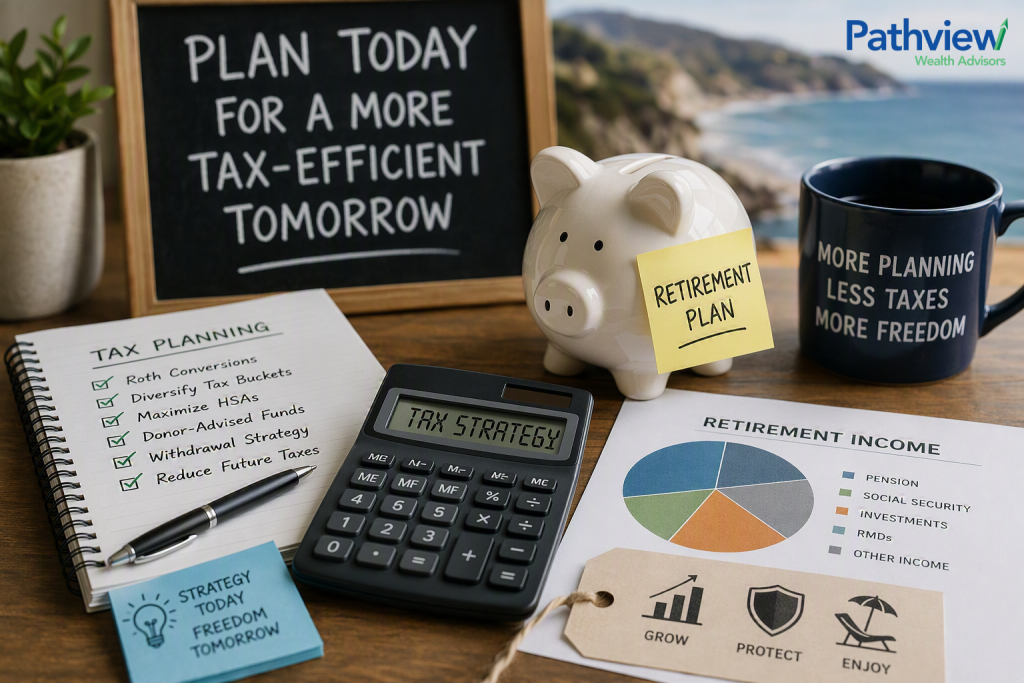
Tax Planning Strategies to Consider Before Retirement
Roth Conversions
Strategic Roth conversions may allow investors to move assets from traditional IRAs into Roth IRAs while managing taxes over time. When implemented thoughtfully, Roth conversions can reduce future RMDs and create greater tax flexibility later in retirement.
Diversify Tax Buckets
Individuals with most of their wealth in pre-tax accounts may face larger future tax obligations. Building assets in Roth accounts, taxable investment accounts, or other after-tax vehicles may provide additional flexibility when generating retirement income.
Maximize Health Savings Accounts (HSAs)
HSAs offer potential tax advantages through deductible contributions, tax-deferred growth, and tax-free withdrawals for qualified healthcare expenses. For many retirees, healthcare costs become a major expense, making HSAs an important planning consideration.
Donor-Advised Funds (DAFs)
For charitable individuals, donor-advised funds can help align philanthropic goals with tax-efficient giving strategies, particularly during years of higher income.
Tax Planning Opportunities During Early Retirement
The years between retirement and the start of RMDs are often among the most valuable planning periods.
Fill Lower Tax Brackets
Many retirees experience reduced income before RMDs begin. This window may create opportunities for Roth conversions while remaining within favorable tax brackets.
Qualified Charitable Distributions (QCDs)
Eligible retirees can use QCDs to donate directly from qualifying retirement accounts to charity. Because QCDs generally do not count as taxable income, they may reduce the tax impact of RMDs.
Optimize Withdrawal Strategies
The order in which assets are withdrawn can significantly affect long-term tax outcomes. A coordinated, tax-first approach often helps create greater flexibility and may improve after-tax retirement income.
The Cost of Doing Nothing
Without proactive retirement tax planning, retirees may encounter:
- Larger-than-expected RMDs
- Higher Medicare premiums due to IRMAA
- Increased taxation of Social Security benefits
- Reduced control over taxable income
- Less flexibility in retirement spending
Final Thoughts
The best time to start retirement tax planning is before retirement arrives. Decisions involving Roth conversions, investment location, withdrawal sequencing, charitable strategies, and account structure can influence lifetime tax outcomes for years to come. Pathview Wealth Advisors, an independent fee only fiduciary and fee only wealth management firm, works with individuals and families seeking a comprehensive tax-first approach to retirement planning.
Whether you are in San Diego or located elsewhere in the United States, our team of fee only CPA + CFP® professionals can help evaluate retirement income strategies and long-term tax considerations.
Contact us today to schedule a retirement tax planning consultation and explore ways to build a more tax-efficient retirement strategy.
This content is for educational purposes only and is not investment, tax, or legal advice. Investing involves risk, including possible loss of principal. Consult your own financial or tax professional before making decisions.
Many people enter retirement without a tax strategy. Common mistakes include delaying Roth conversions, relying too heavily on pre-tax retirement accounts, ignoring future RMDs, claiming Social Security without considering tax consequences, and failing to coordinate withdrawals across different account types.
Taxes can increase when retirees receive income from multiple sources, including Social Security, pensions, RMDs, investment income, and capital gains. Higher income may also trigger Medicare premium surcharges known as IRMAA.
You should start retirement tax planning several years before retirement. Planning early gives you more opportunities to manage tax brackets, complete Roth conversions, reduce future RMDs, and create a tax-efficient withdrawal strategy.
The years between retirement and the start of required minimum distributions often create attractive opportunities for Roth conversions. However, the ideal timing depends on your income, tax bracket, future retirement goals, and overall financial plan.
Roth conversions move assets from a traditional IRA into a Roth IRA. Although you pay taxes on the converted amount today, future qualified withdrawals can occur tax-free, and Roth assets are not subject to lifetime RMDs.
RMDs are mandatory withdrawals from certain retirement accounts. The IRS requires eligible account owners to begin taking distributions at a specified age. Large account balances can create significant taxable income once RMDs begin.
RMDs increase taxable income because the IRS generally taxes withdrawals from pre-tax retirement accounts as ordinary income. Higher RMDs can also increase Medicare premiums and cause a larger portion of Social Security benefits to become taxable.
You may reduce future RMDs through strategies such as Roth conversions, qualified charitable distributions, strategic withdrawals before RMD age, and maintaining assets in tax-diversified accounts throughout your working years.
Tax diversification means holding assets across different account types, including tax-deferred, tax-free, and taxable accounts. This approach can provide greater flexibility when generating retirement income and managing taxes.
Tax diversification allows you to choose where retirement income comes from each year. This flexibility can help you manage tax brackets, reduce Medicare surcharges, and potentially lower lifetime taxes.
Yes. The IRS may tax a portion of your Social Security benefits depending on your total income. Retirement account withdrawals, pensions, and investment income can increase the percentage of benefits subject to taxation.
IRMAA, or Income-Related Monthly Adjustment Amount, increases Medicare Part B and Part D premiums for higher-income retirees. Managing taxable income can help reduce the likelihood of crossing IRMAA thresholds.
Many investors use Health Savings Accounts as part of their retirement strategy because HSAs offer tax-deductible contributions, tax-deferred growth, and tax-free withdrawals for qualified medical expenses.
The best withdrawal strategy depends on your financial situation, tax bracket, and retirement goals. Many retirees benefit from coordinating withdrawals across taxable, tax-deferred, and Roth accounts to improve tax efficiency.
Qualified charitable distributions allow eligible retirees to donate directly from qualifying retirement accounts to charity. QCDs can satisfy part or all of an RMD while generally excluding the donated amount from taxable income.
Yes. Strategies such as qualified charitable distributions and donor-advised funds can help some individuals support charitable causes while potentially improving tax efficiency.
Poor tax planning can lead to larger tax bills, higher Medicare premiums, increased taxation of Social Security benefits, larger RMDs, and reduced flexibility when accessing retirement income.
Many retirees benefit from working with both a CPA and a CFP® professional. A coordinated approach can help align tax strategies, retirement income planning, investment decisions, and long-term financial goals.
A tax-first retirement strategy focuses on managing lifetime taxes rather than only investment returns. By coordinating withdrawals, Roth conversions, Social Security decisions, and charitable strategies, retirees may retain more after-tax wealth throughout retirement.