
Pathview Wealth Advisors helps investors evaluate ETFs vs mutual funds through a fiduciary lens that prioritizes costs, taxes, and long‑term outcomes. When considering ETFs vs mutual funds, it is important to understand the implications for investors. Both investment vehicles offer professional management, diversification, daily liquidity, and SEC oversight under the Investment Company Act of 1940. Both also charge expense ratios. However, their structural differences create meaningful implications for fees and taxes.
As a fee only fiduciary firm led by fee only CPA + CFP® professionals, Pathview Wealth Advisors evaluates every investment on a net‑of‑fees basis. We continuously enhance portfolios to reduce expense ratios and improve after‑tax efficiency—key pillars of effective fee only wealth management.
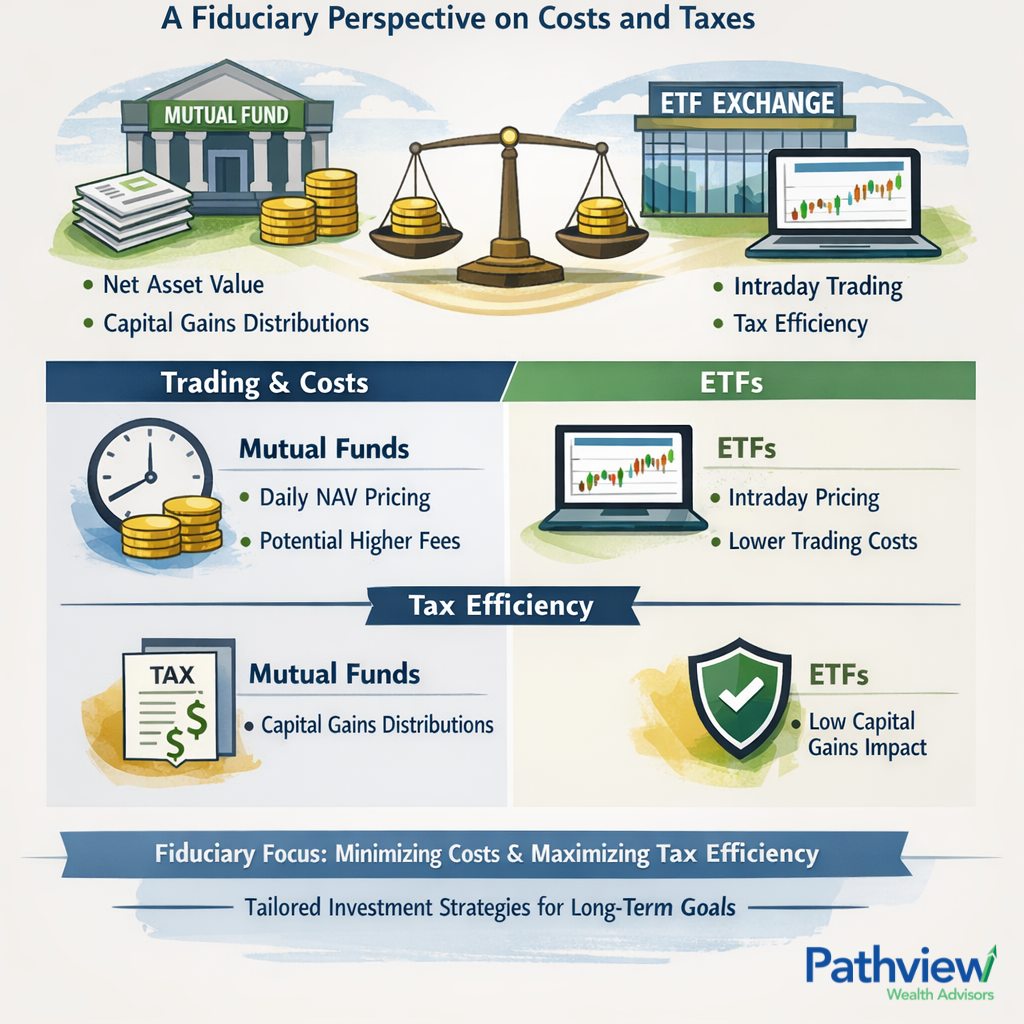
How Trading Structure Affects Costs
Mutual funds execute trades directly with the fund company. Investors buy and sell shares at net asset value (NAV), which the fund calculates once per day after market close. This structure eliminates intraday price movement but limits flexibility.
ETFs trade on an exchange throughout the day, just like individual stocks. Investors transact with other market participants or market makers. This intraday trading introduces a bid‑ask spread, which represents a small transaction cost. In highly liquid ETFs, spreads remain minimal and rarely affect long‑term investors who follow a disciplined approach.
From a fiduciary standpoint, we focus on liquidity, trading efficiency, and implementation—not short‑term price movements or market timing.
Why Fiduciaries Emphasize Tax Efficiency
Taxes often separate ETFs vs mutual funds in real‑world results.
When investors redeem mutual fund shares, the fund may sell underlying securities to raise cash. Those sales can generate capital gains that the fund must distribute to all shareholders. As a result, long‑term investors may incur tax liabilities even when they do not sell shares.
ETFs operate differently. Because investors trade ETF shares on an exchange, the fund usually avoids selling securities to meet redemptions. This structure significantly reduces capital gain distributions. Investors maintain greater control over when they realize taxable gains—an advantage that aligns with a tax‑first investment philosophy.
Effective tax planning often involves coordination with a trusted tax advisor, especially when managing taxable portfolios over multiple market cycles.
Choosing ETFs or Mutual Funds Within a Financial Plan
A fiduciary does not default to one structure in every situation. Instead, Pathview Wealth Advisors evaluates how ETFs and mutual funds fit within each client’s broader financial plan, risk tolerance, and tax profile. Structure, cost, and tax efficiency matter most when they support long‑term goals.
Pathview Wealth Advisors, based in San Diego and serving clients nationwide, helps investors make informed decisions designed to improve after‑tax outcomes and reduce unnecessary complexity. If you want a fiduciary perspective on building a tax‑aware portfolio, Pathview Wealth Advisors stands ready to help. Contact us.
This content is for educational purposes only and is not investment, tax, or legal advice. Investing involves risk, including possible loss of principal. Consult your own financial or tax professional before making decisions.
ETFs trade on an exchange throughout the day like stocks, while mutual funds execute trades once per day at net asset value (NAV) after the market closes. The trading structure directly affects flexibility, costs, and potential tax outcomes.
ETFs often provide better tax efficiency in taxable accounts because their structure reduces capital gains distributions. Mutual funds may distribute gains when they sell securities to meet investor redemptions.
Mutual funds sell underlying securities when investors redeem shares. These sales can generate capital gains, and the fund distributes those gains to shareholders—even if you hold your position.
ETF investors trade shares on an exchange instead of redeeming from the fund. This structure allows ETFs to avoid selling underlying securities in most cases, which reduces capital gains distributions and gives investors more control over taxes.
ETFs can generate capital gains distributions, but many broad, liquid ETFs distribute fewer gains than comparable mutual funds. Their structure helps reduce taxable events for long-term investors.
A bid‑ask spread measures the difference between the highest price a buyer offers and the lowest price a seller accepts. This spread represents a transaction cost in ETFs. In highly liquid ETFs, spreads typically remain small and have minimal impact on long-term investors.
Mutual funds do not charge a bid‑ask spread. Investors transact directly with the fund at end-of-day NAV. However, mutual funds may include other costs depending on the share class and platform.
ETFs do not always cost less than mutual funds. Both structures charge expense ratios, and costs vary by fund and strategy. A fiduciary evaluates total costs, including expense ratios, trading costs, platform fees, and tax impact.
NAV represents the per-share value of a mutual fund. The fund calculates NAV at the end of each trading day, and all buy and sell orders execute at that price.
You can trade ETFs throughout market hours because they trade on exchanges. This structure provides flexibility for execution, but disciplined investors typically avoid intraday trading for market timing.
ETFs and mutual funds both provide diversification, professional management, daily liquidity, and regulatory oversight. The key differences come from trading structure, cost efficiency, and tax treatment.
The structure does not determine safety. The underlying investments, asset allocation, and strategy drive risk. Investors should evaluate risk based on holdings, not whether the investment uses an ETF or mutual fund wrapper.
Investors often choose ETFs in taxable accounts because ETFs typically improve tax efficiency. However, a fiduciary evaluates the decision based on the investor’s overall plan, tax situation, and portfolio strategy.
Tax efficiency matters less in IRAs and other tax-advantaged accounts because investments generally do not trigger annual taxes. Investors should prioritize cost, diversification, and strategy when selecting funds in these accounts.
Some mutual funds can match ETF tax efficiency when they share a structure with ETF share classes. In these cases, the fund may deliver similar tax outcomes.
A fiduciary evaluates costs, tax impact, liquidity, and implementation within the context of a full financial plan. The goal focuses on improving after-tax outcomes and reducing unnecessary complexity.
A fiduciary focuses on net-of-fees and after-tax results rather than labels. Many portfolios favor ETFs because they often improve tax efficiency and help reduce capital gains distributions.