
Incentive stock options tax planning is essential for professionals who want to maximize equity compensation, and at Pathview Wealth Advisors, we emphasize a tax-first approach led by coordination between a CPA + CFP® professional. While ISOs offer valuable tax advantages, they also come with complex timing rules and potential pitfalls—most notably the Alternative Minimum Tax (AMT).
What Are Incentive Stock Options (ISOs)?
ISOs give you the ability to purchase company stock at a fixed exercise price. Typically:
- You have up to 10 years to exercise
- Departure from your employer shortens the window to 30–90 days
- Value is created if the stock price rises above your exercise price
A tax-first lens—guided by a CPA + CFP® team—helps ensure these decisions align with your broader tax planning and investment strategy
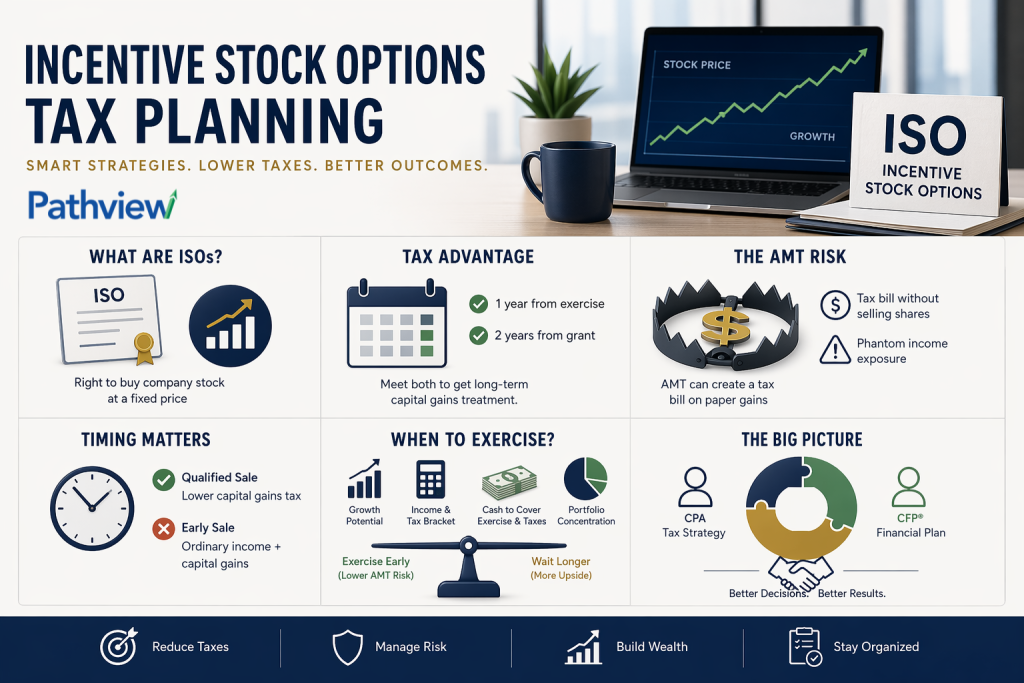
How ISO Tax Rules Work
To receive favorable long-term capital gains treatment:
- Hold shares at least 1 year after exercise
- Hold shares at least 2 years after grant
If both are satisfied, gains are taxed at lower capital gains rates. If not, the sale becomes a disqualifying disposition, and part of the gain is taxed as ordinary income. A fee only fiduciary approach ensures these decisions prioritize your outcome—not product sales.
The AMT Trap
The AMT is one of the biggest risks in incentive stock options tax planning. Although exercising ISOs does not create regular taxable income, the “spread” between exercise price and market value is included in AMT income.
This can result in:
- A tax bill without selling shares
- Significant “phantom income” liability
With a tax-first strategy, your CPA + CFP® professional can model AMT exposure before exercising—helping you avoid costly surprises.
When You Sell Matters
Timing affects your tax outcome:
- Qualified sale: Entire gain taxed at capital gains rates
- Early sale: Combination of ordinary income and capital gains
A coordinated plan between your tax advisor and fee only CFP® professional helps optimize when to sell based on your income, tax bracket, and long-term goals.
When to Exercise Your ISOs
Key factors include:
- Company growth potential
- Current income and tax bracket
- Cash available to cover exercise and taxes
- Portfolio concentration
Exercising early may limit AMT exposure, while waiting can increase upside—but also risk. A fee only wealth management plan ensures these trade-offs are evaluated holistically.
Final Thoughts
ISOs can be a powerful wealth-building tool—but only if managed proactively. At Pathview Wealth Advisors, we integrate incentive stock options tax planning into a tax-first framework driven by collaboration between a CPA + CFP®, helping you reduce taxes, manage risk, and align equity decisions with your overall financial plan. Based in San Diego and serving clients nationwide, Pathview Wealth Advisors provides coordinated, fiduciary guidance designed to improve long-term outcomes. Contact us.
This content is for educational purposes only and is not investment, tax, or legal advice. Investing involves risk, including possible loss of principal. Consult your own financial or tax professional before making decisions.
You reduce taxes on incentive stock options by using a tax-first strategy that coordinates exercise timing, holding periods, and income levels. A CPA + CFP® professional can help you model scenarios, manage AMT exposure, and plan sales to maximize long-term capital gains treatment.
You should exercise your ISOs when it aligns with your income, market conditions, and AMT exposure. Many investors benefit from early or staggered exercises to reduce the tax impact. A CPA + CFP® team can help you determine the optimal timing based on your financial plan.
You do not pay regular income tax when you exercise ISOs, but you may trigger the Alternative Minimum Tax (AMT). The spread between your exercise price and the stock’s market value counts toward AMT income, so a tax-first approach is critical before exercising.
You trigger AMT when you exercise ISOs and create a large spread between the exercise price and fair market value. This “phantom income” increases your AMT liability, even if you do not sell shares. A CPA + CFP® professional can help you calculate and manage this risk.
You reduce or avoid AMT by exercising shares gradually, exercising earlier when spreads are smaller, or selling shares in the same year you exercise. A tax-first strategy led by a CPA + CFP® allows you to proactively manage AMT exposure instead of reacting after the fact.
A qualifying disposition occurs when you hold ISO shares for at least one year after exercise and two years after the grant date. Meeting both requirements allows you to pay long-term capital gains tax rates, which are often lower than ordinary income rates.
If you sell ISOs before meeting holding requirements, you create a disqualifying disposition. You then pay ordinary income tax on part of the gain, which can significantly increase your tax liability. A CPA + CFP® team helps you evaluate whether early selling makes sense.
You should decide whether to hold or sell based on tax impact, risk tolerance, and portfolio diversification—not just potential gains. A tax-first framework ensures you weigh concentration risk and tax consequences together with a CPA + CFP® professional.
Yes, ISOs can expire worthless if the stock price stays below the exercise price or you do not exercise within the allowed timeframe. While this creates no tax liability, it highlights the importance of proactive incentive stock options tax planning.
You should use a CPA + CFP® because ISOs require both advanced tax modeling and comprehensive financial planning. A coordinated, tax-first approach ensures you optimize timing, reduce taxes, and align equity decisions with your long-term goals.
A tax-first strategy improves ISO outcomes by prioritizing tax efficiency before making exercise or sale decisions. Instead of reacting to tax consequences, you proactively structure your strategy with a CPA + CFP® to minimize liabilities and maximize after-tax returns.
Incentive stock options can offer better tax treatment than RSUs if you meet holding requirements and qualify for long-term capital gains. However, they also introduce AMT risk. A CPA + CFP® professional can help you compare both and build a tax-first plan.
You plan ISO taxes as a high-income earner by carefully managing AMT exposure, spreading exercises over multiple years, and aligning transactions with your broader tax strategy. A tax-first approach with a CPA + CFP® is essential in higher tax brackets.